Saturday, July 31, 2010

Dicte

Dicte started to play at a very young age and first appeared in 1983 with original songs and tracks from Janis Joplin's repertoire. She played in the beginning with a band from Viborg, called Farandola, but in 1987 she moved to Aarhus, where she played in many different contexts, until 1989 when she formed the group Her Personal Pain. Shortly after the formation ran in and won the talent competition Vi har scenen - har I musikken.
This band released in 1990 a disk with six songs. They went in a tour across the country and therefore the group was well known in music circles, not so much the general public, despite
a successful concert at the Roskilde Festival in 1990. This band participated in a support disk for Amnesty International, and in 1992 finally appeared Her Personal Pains first independent album.

However, this group was disbanded in 1993, when Dicte went solo. Dicte first solo album was released in 1994, and was rewarded with a three annual grant from the State Arts Foundation. She has since released several albums with the original concept that makes Dicte to an energy of Danish music. She has not been afraid to try other genres such as jazz, classical and R & B, although rock is most evident in her music.

In addition, she has tried their hand at film and theater as an actor, right she has created music for theater pictured out. Gradually, Dicte assembled a band named The Sugarbones, where she plays guitar and sings along with, among other things her longstanding collaborator operational part that requests Gliemann on keyboards.

Dicte was nominated for Danish Music Awards 2007 as the Danish Singer of the Year.
The Sugarbones:
Kæv Gliemann - keyboards, guitars, programs and choir
Mika Vandborg - guitars and choir
Lennart Ginman - bass
Thomas Duus - drums and choir

Thursday, July 29, 2010

Scandinavian Airlines

SAS was founded on 1 August 1946 when Det Danske Luftfartselskab A/S, AB Aerotransport and Det Norske Luftfartselskap AS (the flag carriers of Denmark, Sweden and Norway) formed a partnership to handle intercontinental traffic to Scandinavia. Operations started on 17 September 1946. The companies then started coordination of European operations in 1948 and finally merged to form the current SAS Consortium in 1951. When established the airline was divided between SAS Danmark (28.6%), SAS Norge (28.6%) and SAS Sweden (42.8%), all owned 50% by private investors and 50% by their respective governments. SAS gradually acquired control of the domestic markets in all three countries by acquiring full or partial control of several local airlines. In May 1997 SAS formed the global Star Alliance network with Air Canada, Lufthansa, Thai Airways International and United Airlines.
Scandinavian Airlines System Aktiebolag, trading as SAS Group and SAS AB, is a holding company based in Solna, Sweden. It is the parent company of the airlines Scandinavian Airlines, Blue1 and Widerøe, and the aviation services companies SAS Business Opportunities, SAS Cargo Group, SAS Ground Services and SAS Technical Services. It holds minority ownership of Air Greenland, Estonian Air, Skyways Express and Spanair. The company is listed on the Oslo Stock Exchange, the Stockholm Stock Exchange and the Copenhagen Stock Exchange.
There exists a SAS Museum at Oslo Airport, Gardermoen, where the exhibits represent an important part of Scandinavian civil aviation history. The museum collections cover Scandinavian Airlines System (SAS) as well as its parent companies: AB Aerotransport (ABA), Det Danske Luftfartselskab (DDL) and Det Norske Luftfartselskap (DNL). SAS is an important North European company, some of their flights may be very expensive. For instance the costs bellow: 
- a fly, 2ways, from Copenhagen to New York costs 4000 DKK (533 Euro)
- a fly, one way, from Copenhagen to Aalborg costs 295 DKK (40 Euro)
- a fly, 2 ways, from Copenahgen to Bangkok costs 6345 DKK (846 Euro)

Monday, July 26, 2010

Aarhus Airport

Aarhus Airport (AAR) is a civilian airport located in Tirstrup, Denmark, which is in Northeast of Aarhus. The website of this airport is www.aar.dk Even this airport is not very big, it offers a lot of facilities and is very well maintained. There is also a summer garden for the smokers or for the people who really like nature.
There are taxis traveling to the city available from outside the terminal building. The cost of a taxi from Aarhus to the airport is about 500 DKK (around 67 Euro). There are 45 Km from Aarhus center to the airport. The cost of a bus travel is 150 DKK per person (around 20 Euro).
An airport bus service takes passengers from the airport to Aarhus and back. It is available 24 hours a day. Also, bus route 212 between Ebeltoft and Randers stops at the airport.
The operating airlines on this airport are:
- British Airways operated by Sun Air of Scandinavia for Gothenburg-Landvetter, Oslo-Gardermoen, Stockholm-Bromma,
- Bulgarian Air Charter for Burgas [seasonal] and Varna [seasonal]
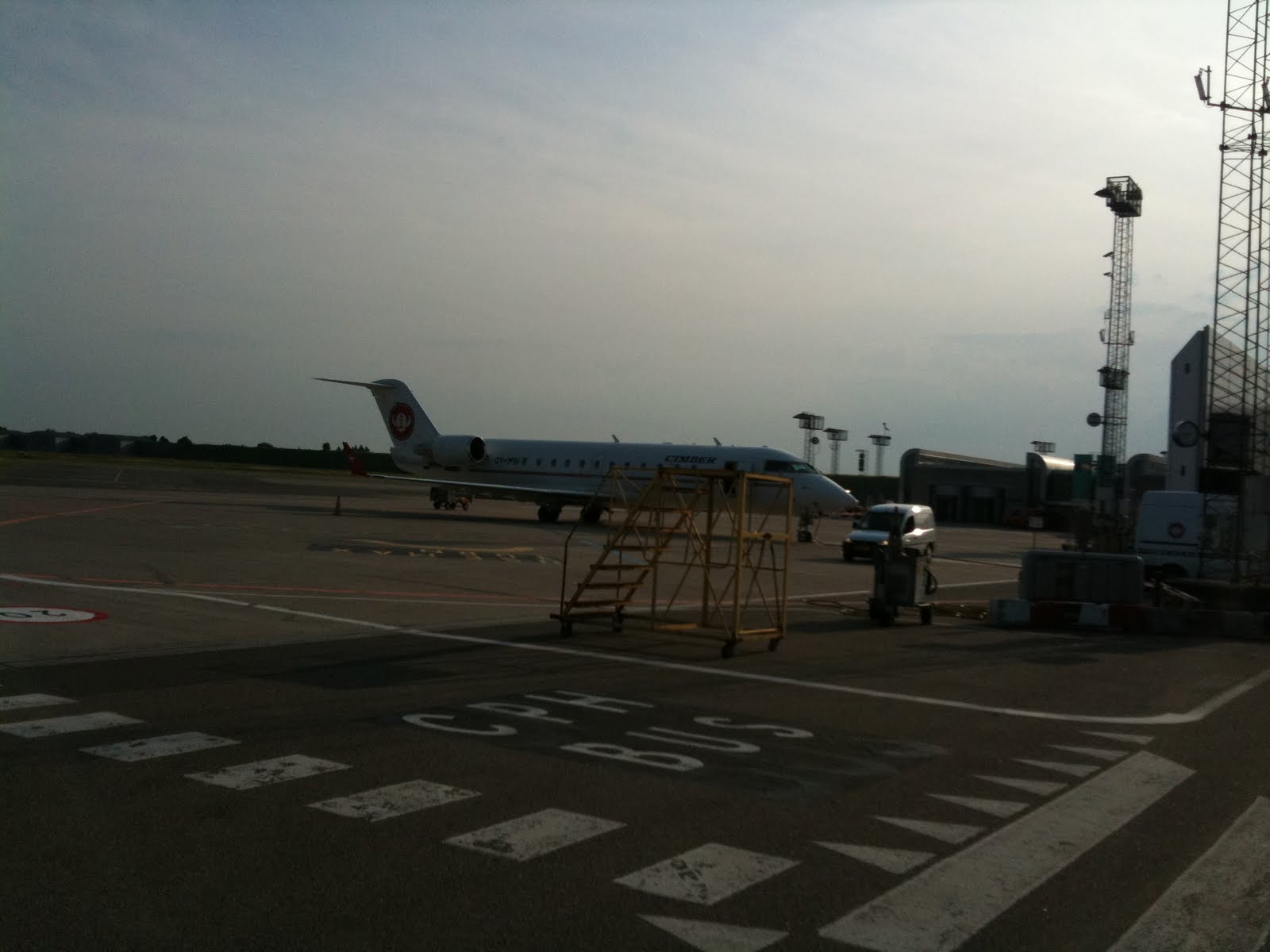
- Cimber Sterling for Copenhagen
- Ryanair for Alicante [seasonal], Girona [seasonal], London-Stansted, Málaga and Oslo-Rygge
- Scandinavian Airlines (SAS)for Copenhagen
People are very kind and warm on this airport. The prices for services inside are affordable in respect with the prices in Denmark which are considered to be really high. More about Aarhus here .

Monday, July 12, 2010

CV Jørgensen

Carsten Valentin (CV) Jørgensen (born 9th of May 1950, in Lyngby) is a Danish singer and songwriter. Between The name Valentine is not lawfully recognized in Denmark.
C.V. Jørgensen has a creative style with numerous metaphors who lifted him level from pop singer to poet who enjoys recognition among writers and poets. The keynote of his texts are a melancholy fervor that often borders on direct alarmism, biting social satire or short fables about human destinies.

C.V. Jørgensen got the two album releases in relative obscurity his breakthrough with the folk rock LP: Storbyens små oaser (1977), where his satirical texts are about Danish allotment idyll and the academic intelligentsia.

The style was continued throughout the 1980s, when Jorgensen's texts were clear opposition to the yuppie and bourgeois political domination. In 1980 he recorded the album Tidens Tern together with the US-Danish guitarist Billy Cross' Delta Cross Band. Although the album's song Costa del Sol that is a satire of rich Danish retired flight to tax havens at the Spanish coast. Cross and Jorgensen, shortly after they finished it, break up their collaboration.

In January 2006, Tidens Tern was selected to be part of the Culture Ministry's cultural canon in category of popular music.

In the 1990s C.V. Jørgensen shifted to a radical style of the album Sjælland (1994), which mixed pop sound with floating, free jazz-inspired brass. The musical focus was moved from a standard rock format to a more free style with an emphasis on atmosphere. Texts shifted from the wordy, narrative style to tight feeling images. A style that he continued eight years later in his album Fraklip fra det fjerne(2002).

C.V. Jørgensen has in his career worked with a number of Danish rock music profiles, including Ivan Horn, Tim Christensen, Aske Jacoby, Sanne Salomonsen, Gert Smedegaard, Niels Henriksen. In late summer 2009 turned CV Jørgensen for the first time in seven years back to the stage, with three concerts in Århus Festival.

Wednesday, July 07, 2010

Hej Matematik

Hej Matematik is a Danish pop band, consisting of the Aqua-member Søren Rasted and his nephew Nicolaj Rasted. They did well on the Danish charts and their debut album was being marketed as "an intelligent pop record" which is most likely a reference to the songs' equivocal lyrics and atmosphere commenting on urban lifestyle. They won Danish Hit of the Year with the single Walkmand at Zulu Awards 2009 - an annual award-ceremony held by Denmark's largest commercial television station TV 2.
In November 2nd, 2009, Hej Matematik released Party I Provinsen, the lead single of their forthcoming second album. The album has been released in Denmark on January 25th, 2010, under the title "Alt Går Op I 6".
Søren Rasted together with Lene Nystrøm, René Dif and Claus Norréen started the Danish success band Aqua.

Hej Matematik had in the past a dispute with well known band R.E.M. These pretended the video Hej Matematik - Walkmand is too close of R.E.M. - Supernatural Superserious. As a consequence they contacted YouTube and asked them to block the video of the Danish band.

Thursday, June 17, 2010

Samsø - Energy Island

Samsø also written Samsoe, is a Danish island in the Kattegat 15 kilometers of the Jylland Peninsula. The community has 4,300 inhabitants, most of them retired people, called Samsingers and it covers an are of 114 km². Due to its central location, the island was used during the Viking Age as a meeting place. People in Samsø like to say that Samsø is center of Denmark, and center of Europe also.
In 1997, Samsø won a government competition to become a model renewable energy community. Now this island is 100% energeticaly independent. An offshore wind farm comprising 10 turbines (making a total of 21 altogether including land-based windmills), was completed, funded by the islanders. The people of Samsø heat their homes with straw burned in a central heating system and they power some vehicles on biofuel which they also grow. Now 100% of its electricity comes from wind power and 75% of its heat comes from solar power and biomass energy.
An Energy Academy has opened in Ballen, with a visitor education center. You can find its website here.
The island is very popular for strawberry picking during the months of June and July every year. In Denmark, the island is well-known for its early potatoes. The first few pounds of potatoes usually fetch prices around £100, and are considered a great delicacy. Ballen's beach and village are popular with visitors; it is served by the bus which runs around the island, including the ferry terminals. In clear weather, you can see the peninsula of Helgenæs to the north.
For a community of more than 4300 people there is only one policeman on this island. That is because there is zero criminality on Samsø.

Friday, February 19, 2010

Crazy Christmas Cabaret 2009

This is a well known English show directed by Vivienne McKnee but played in Denmark. They have made a play every year since 1982 choosing a popular theme. It is really fun and the costumes are amazing. The theater company is called London Toast.
The actors are David Bateson, Andrew Jeffers, Bennet Thorpe, Katrine Falkenberg, Elliot Russo, Vivienne McKnee, Rene Andersen, Kirsten Brink, Peter Friis, Barry McKenna, Peter Dijring, Søren Bruunsgaard Petersen, Tom Høklund Olsen, Stuart Goodstein
The main character of this play is Dr. Bent van Helsingør. He was born in Elsinore and graduted Hamlet University. He went vampire hunting in Transylvania. After a near-death experience in 1986, fighting count Dracula, Bent started his fabulous acting career with London Toast Theater. He appeared in no less than 21 Crazy Christmas Cabarets. TV appearances include Hopla, Aha, Hooray&Boo and TV avisen. He established "Hyggeligans United" and his own touring band "Gammel Dansk" (best known for his rap hit "Hello I must be going!"). This year he is happy to be "consiliere" to the Godfather and warns you to be aware of bankers.

Wednesday, December 02, 2009

Aalborg

Aalborg is a city in Denmark having 122,461 inhabitants and being the fourth largest city in the country after Copenhagen, Aarhus, and Odense. It is located by the Limfjord and was an important harbour during the Middle Ages, and an industrial centre later. Today the city is in a transition from a working-class, industrial city to a knowledge-based one.

Aalborg is located 120 kilometres north of Aarhus and 414 kilometres (by Great Belt Fixed Link) to Copenhagen.

The old Aalborghus Castle (Aalborghus Slot) and some picturesque houses of the 17th century can be seen in the center of the town. The half-timbered (bindingsværk) castle was built in 1550 by King Christian III, and was converted to government administration offices in the 1950. Jens Bang's House, a five story building built in 1624 by the merchant Jens Bang is an example of Renaissance architecture. It is located on Nytorv next to the old Town Hall. The present Budolfi Church was built at the end of the 14th century, although at least two earlier churches stood on the same spot. Budolfi Church was just a parish church until it became the seat of the Lutheran bishop of Aalborg in 1554.

Vor Frue Kirke ("Church of Our Lady") is a relatively modern church. The original Church of Our Lady from the early 1100s was pulled down after the Reformation because it was so old and unstable. The newer building in a different location was partially burned in 1894. Underneath the main pedestrian shopping street is a newly opened museum of the excavation of a monastery from the 11th century. Nørresundby is the site of the Lindholm Høje settlement and burial ground from the Germanic Iron Age and Viking times. There is also a museum on the site.

Aalborgtårnet is a tripod tower erected in 1933. The tower still gives an exquisite view over the fjord and the city from its 105 m rise over the sea level. Near the Aalbor Tower you find KUNSTEN Museum of Modern Art Aalborg an art museum built in 1972 designed by the Finnish architect Alvar Aalto. In 2008 the Utzon Center, dedicated to the work of the noted architect Jørn Utzon, was built next to the Limfjord at the central harbour front in Aalborg.

Nordkraft is a cultural centre in a former power plant near the harbour. It has theatres (opening in 2010), a cinema, concert facilities. In its neighbourhood a classical concert hall, Musikkens Hus and so one.

One of the most popular and famous streets in Aalborg, possibly even in Denmark, is Jomfru Ane Gade, or simply just Gaden ("The Street"). The name translates to "Mistress' Anne's Street" in English. The pubs and restaurants on this street offer beer and other spirits for some of the most competitive prices in Denmark. Jomfru Ane Gade is a café and restaurant street during day which, at night, turn into clubs, discos and bars. During the 1990s the street was infamous for being a 'hang out' of two biker gangs who were at war for some years all over Scandinavia, but as the bikers disappeared from the street it became even more popular among people of all ages. During the day, tourists and employees in the city come to Jomfru Ane Gade, especially for its restaurants. In the afternoons some of the cafés open. Around 11 pm the mood of the street changes into more of a party street when younger people arrive.

The annual Aalborg Carnival takes place in the weekend of week 21 (usually the last week in May). The Carnival is actually three events, the children's carnival (Børnekarneval), the battle of carnival bands, and the carnival itself. During the carnival, Aalborg receives about 100,000 people. The Carnival ends with a grand firework display.

Saturday, November 14, 2009

Millennium - Trilogy

The Millennium Trilogy is a series of three bestselling novels written by Stieg Larsson. The novels in the series, The Girl with the Dragon Tattoo, The Girl Who Played with Fire and The Girl Who Kicked the Hornets' Nest, were first published in 2005, 2006 and 2007 respectively.

The trilogy has been made into three films, the first "Män som hatar kvinnor" (Men Who Hate Women) is available on DVD, but in Swedish with Scandinavian languages subtitles only, the second "Flickan som lekte med elden" (The Girl Who Played with Fire) had a cinema release on September 18, 2009, the third "Luftslottet som sprängdes" (The Girl Who Kicked the Hornets' Nest) is supposed to have its cinematic release on November 27, 2009.

"Män som hatar kvinnor" (Swedish for "Men who hate women," renamed in the English translation as The Girl with the Dragon Tattoo) is an award-winning novel by the late Swedish author and journalist Stieg Larsson, the first in his "Millennium Trilogy". At his death in November 2004 he left three unpublished novels that made up the trilogy. It became a posthumous best-seller in Europe.

Filming began in early 2008, and "Men Who Hate Women" (the film title of The Girl with the Dragon Tattoo), opened in Sweden, Denmark, Norway, and Finland in February-March 2009. So far, it has been seen by more than 2.5 million people in those countries. In Norway and Denmark it is the most viewed Swedish film ever, and in Sweden total admissions are above one million.

The films have been sold to Sweden, Denmark, Norway, Finland, Germany, France, Italy, Greece, Spain, Belgium, the Netherlands, Switzerland, Luxemburg and Poland.


The Girl Who Played with Fire (original title in Swedish: "Flickan som lekte med elden") is the second novel in the million-selling Millennium Trilogy by Swedish writer Stieg Larsson. The book features many of the characters that appeared in The Girl with the Dragon Tattoo, among them Lisbeth Salander, the "Girl" of the title and a social misfit hacker, and Mikael Blomkvist, a investigative journalist and publisher of Millennium magazine. Widely seen as a critical success, The Girl Who Played with Fire was also (according to The Bookseller magazine) the first and only translated novel to be number one in the UK hardback chart.

For non-Swedish readers of the book, it might be interesting to know that the character of Paolo Roberto is not a fictional character. He is an ex-boxer and TV-chef who also dabbled in politics. He is featured in some very important chapters and will play himself in the film based on the book.

The Girl Who Kicked the Hornets' Nest (original title in Swedish: "Luftslottet som sprängdes") is the third and final novel in the million-selling Millennium Trilogy by Swedish writer Stieg Larsson. It was published posthumously in Swedish in 2007 and was published in English in the UK in October 2009. The Swedish title literally means "The Air Castle that was blown up". Luftslott ("Air castle") is used in Swedish to designate a pipe dream.

Tuesday, October 06, 2009

Tina Dickow - Tina Dico

Tina Dico (born Tina Dickow on October 14, 1977) is a singer and songwriter inspired by artists such as Tracy Chapman, Bob Dylan and Leonard Cohen.

In her home country of Denmark, she worked with the lead singer of the band TV-2, Steffen Brandt. She won a Steppeulv and a Danish Music Award in 2004 for her album, Notes, and the award for best female vocalist at the Danish Music Awards 2006. Internationally, she may be best known for her collaboration with the English duo Zero 7 on their second album, When It Falls, with the song "Home" and "The Space Between". In Denmark she performs under her real name, Tina Dickow.

Dickow was born in Åbyhøj near Århus, Denmark. At a very young age, she was introduced to music by her father who owned a big hi-fi stereo system in their basement. After public school, she attended a music boarding school, and after that she went to high school. Music still was her passion, and during her first years she performed with the cover band, Fester Kester.

In 1997 while attending her third year at high school, she was cast in the erotic TV-series, Karrusel (Carrousel), where she starred with Peter Steen and Michael Falch (produced 1997, broadcast 1998 on Danish TV2). After her performance she was offered several parts but did not like to be type cast as the "naive girl from Jutland," which was why she refused every offer. While Dickow performs under her real name in Denmark, abroad she is known as Tina Dico in order to avoid mispronunciation by American English speakers.

In 1998, Dickow introduced the other members of the band Fester Kester to a song of her own, and their enthusiasm led them to enter, and win, two talent contests the same year: "Talentspot" on Danish TV2, and "Vi har scenen, har I musikken?" (We have the stage, do you have the music?) in Aarhus. The band "Tina Dickow and Sheriff" was formed in 1998, and later that year the single "Your Waste of Time" was released. It was picked as "Song of the Week" on Danish National Radio, P3, and led to some degree of fame.

Several conversations with established record labels followed, but Dickow was unhappy with the way they intended to market her. Instead she got a loan from a bank, and started her own record label, Finest Gramophone, in 2000. The company’s first release was Dickow’s Fuel in 2001. The critic's response was modest, but most recognized her potential as an artist. Also in 2001, Dickow teamed up with her current manager, Jonathan Morley, on the SPOT-festival in Aarhus. She signed a four-year contract with Morley, and during the 2002 MIDEM-festival in Cannes, France she signed with English publisher Kojam Music.

Finest Gramophone went on to sign another Danish act, Love Julie, which released two albums. Dickow has said that she has no intention of signing future acts, due mostly to time constraints.

In the beginning of 2002, Dickow moved to England in an attempt to escape from the cozy atmosphere in Denmark. Thanks to her contract with Morley, she had the opportunity to step into the English music community, which led to a collaboration with Australian singer Holly Valance on the song "Send My Best." Dickow wrote the album Notes during her stay in England, capturing the loneliness and fear of being alone in London. Notes was recorded in two days and was released later that year. The critics were very positive this time. Notes won a Steppeulv (the Danish music critics award) in the category "Composer of the Year" and a Danish Music Award for "Songwriter of the Year".

During her work with Valance, Dickow met Sam Hardaker, one of the members of the English trip-hop-lounge duo, Zero 7. She was asked to collaborate with them, and they recorded "Home" and "The Space Between" which are featured on the album When It Falls. A tour with more than 100 shows in Europe, U.S., and Asia followed. While Dickow does not appear on Zero 7's The Garden, she has stated her desire to someday work with Zero 7 again.

The EP Far, with new versions of some of the tracks from Notes, one track from Fuel and a brand new song, was released in 2004. The purpose of the EP was to follow up on the success from the Zero 7 tour. In 2004, Dickow signed a multinational record deal with Sony UK, and the recordings to her international debut begun in late 2004. In early 2005, Sony and BMG merged, and the deal was canceled. The legal rights to the songs were handed over to Dickow, and the album was released in cooperation with the Danish company, A:Larm in June 2005. The album went straight to No. 1 on the Danish album chart in front of prominent names such as U2 and Coldplay.

In January 2006, Dickow won the P3 Award and DKK 100,000 which is granted by Danish National Radio P3. The jury said this of Dickow's effort: “Courage, self-esteem and talent is required if you want to be yourself and perform your own songs – without overstyled fuss. The winner of the P3 Award certainly possesses these qualities.” In March 2006, Dickow won the Danish Music Award for "Singer of the Year".

Dickow has released her fourth studio album entitled Count to Ten on September 3rd, 2007.
In September 2008, Dickow won the Kronprinsparrets Kulturpris and DKK 500,000 which was granted by Crown Prince Frederik of Denmark for “having the courage to look the contradictory and difficult parts of existence in the eye, and for the ability to express it in a very special, life-affirming fashion that many can identify themselves with.”

Discography

Fuel (2001)
Notes (2003)
Far (EP, 2004)
In the Red (2006)
Count To Ten (2007)
Instant Karma: The Amnesty International Campaign to Save Darfur" (2007) Tina Dico (listed as Tina Dickow) cover of Working Class Hero (John Lennon)
Side By Side - duets Vol. 1" Award-winning American artist AM (musician) and Tina Dico perform the duet "While My Guitar Gently Weeps" (2008) a cover of a George Harrison song
A Beginning, A Detour, An Open Ending (2008)

Sunday, September 06, 2009

Vienna - Capital of Austria


Vienna is the capital of the Republic of Austria and also one of the nine states of Austria. Vienna is Austria's primary city, with a population of about 1.7 million (2.3 million within the metropolitan area), and is by far the largest city in Austria, as well as its cultural, economic, and political centre. It is the 10th largest city by population in the European Union. 


Vienna lies in the east of Austria and is close to the Czech Republic, Slovakia and Hungary.


The English name of Vienna, the German name Wien, and the names of the city in most languages, are thought to be derived from the Celtic name of a settlement, but opinions vary on the precise origin. Some claim that the name comes from Vedunia, meaning "forest stream", which subsequently became Venia, Wienne and Wien. Others claim that the name comes from the name of the Roman settlement Vindobona, probably meaning "white base/bottom", which became Vindovina, Viden and Wien. The name of the city in Hungarian (Bécs), Bosnian, Croatian and Serbian (Bec) and Ottoman Turkish (Beç) appears to have a different, Slavonic, origin.
Founded around 500 BC, Vienna was originally a Celtic settlement. In 15 BC, Vienna became a Roman frontier city (Vindobona) guarding the Roman Empire against Germanic tribes to the north. In the 13th century, Vienna came under threat from the Mongolian Empire, which stretched over much of present-day Russia and China. However, due to the death of its leader, Ogedei Khan, the Mongolian armies receded from the European frontier and did not return.

During the Middle Ages, Vienna was home to the Babenberg Dynasty, and in 1440 AD, it became the resident city of the Habsburg Dynasties, then it eventually grew to become the capital of the Holy Roman Empire and a cultural centre for arts and science, music and fine cuisine. In the 16th and 17th centuries, the Ottoman armies were stopped twice outside Vienna (see Siege of Vienna, 1529 and Battle of Vienna, 1683).

In 1804, Vienna became the capital of the Austrian Empire and continued to play a major role in European and world politics, including hosting the 1814 Congress of Vienna. After the Austro-Hungarian Compromise of 1867, Vienna remained the capital of what was then the Austro-Hungarian Empire. During the latter half of the 19th century, the city developed what had previously been the bastions and glacis into the Ringstraße, a major prestige project. Former suburbs were incorporated, and the city of Vienna grew dramatically.

In 1918, after World War I, Vienna became capital of the First Austrian Republic. During the 1920s and 1930s, it was a bastion of socialism in Austria, and was known as the "Red Vienna." The city was a stage to the Austrian Civil War of 1934, when Chancellor Engelbert Dollfuss sent the Austrian Army to shell civilian housing occupied by the socialist militia. In 1938, after a triumphant entry into Austria, Adolf Hitler famously spoke to the Austrian people from the balcony of the Neue Burg, a part of the Hofburg at the Heldenplatz. Between 1938 (Anschluß) and the end of the Second World War, Vienna lost its status as a capital to Berlin.

In 1945, the Soviets successfully launched the Vienna Offensive against Germans who were holding Vienna. The city was besieged for about two weeks before it fell to the Soviets. After 1945, Vienna again became the capital of Austria, was initially divided into zones by the four powers (or the four prevailing nations), and was governed by the Allied Commission for Austria. The four-power occupation of Vienna differed in some respects from the four-power occupation of Berlin: the central area of Vienna had an international zone in which the four powers alternated on a monthly basis. When the Berlin blockade occurred in 1948, Vienna was even more vulnerable because there was no airport in the western sectors. However, despite fears, the Soviets did not blockade Vienna. Some have argued that this was because the Potsdam Agreement gave written rights of land access to the western sectors, whereas no such written guarantees had been given regarding Berlin. The true reason will, however, always remain a matter of speculation. During the 10 years of foreign occupation, Vienna became a hot-bed for international espionage between the Western and Eastern blocs. The atmosphere of four-power Vienna is captured in the Graham Greene novel The Third Man and by the movie which followed.

In the 1970s, Austrian Chancellor Bruno Kreisky inaugurated the Vienna International Centre, a new area of the city created to host international institutions. Vienna has regained a part of its former international relevance by hosting international organizations, such as the United Nations (UNIDO, UNOV, CTBTO and UNODC), the International Atomic Energy Agency, the Organization of Petroleum Exporting Countries, and the Organization for Security and Cooperation in Europe.

Due to the industrialization and immigration from other parts of the Empire, the population of Vienna increased sharply during its time as the capital of Austria-Hungary (1867–1918). In 1910, Vienna had more than 2 million inhabitants, and was one of the six largest cities in the world. At the turn of the century, Vienna was the city with the second largest Czech population in the world (after Prague). However, after World War I, many Czechs and Hungarians returned to their ancestral countries, resulting in a decline in the Viennese population. At the height of the migration, about one-third of the Viennese population were of Slavic or Hungarian origin. By 2001, 16% of people under the census living in Vienna had nationalities other than Austrian, nearly half of whom were from former Yugoslavia, primarily Serbs; the next most numerous nationalities in Vienna were Turkish (39,000 or 2.5%), Polish (13,600 or 0.9%) and German (12,700 or 0.8%). However, the real numbers of people of different nationalities living today in Vienna is much higher due to high numbers of individuals not being counted in the census who either do not possess Austrian citizenship or who live illegally in Austria.

Vienna is located in north-eastern Austria, at the easternmost extension of the Alps in the Vienna Basin. The earliest settlement, at the location of today's inner city, was south of the meandering Danube while the city now spans both sides of the river. Elevation ranges from 151 to 524 m (495 to 1,719 ft). Vienna has a humid continental climate according to the Köppen classification. The city has warm summers with average high temperatures of 22 - 26°C (72 - 79°F), with maxima exceeding 30°C (86°F) and lows of around 15°C (59°F). Winters are relatively cold with average temperatures at about freezing point, and snowfall occurring mainly from December through March. Spring and autumn are cool to mild. Precipitation is generally moderate throughout the year, averaging 620 mm (24.4 inches) annually.

Major tourist attractions include the imperial palaces of the Hofburg and Schönbrunn (also home to the world's oldest zoo, Tiergarten Schönbrunn) and the Riesenrad in the Prater. Cultural highlights include the Burgtheater, the Wiener Staatsoper, the Lipizzaner horses at the spanische Hofreitschule and the Vienna Boys' Choir, as well as excursions to Vienna's Heuriger districts.

There are also more than 100 art museums, which together attract over eight million visitors per year. The most popular ones are Albertina, Belvedere, Leopold Museum in the Museumsquartier, KunstHausWien, BA-CA Kunstforum, the twin Kunsthistorisches Museum and Naturhistorisches Museum, and the Technisches Museum Wien, each of which receives over a quarter of a million visitors per year.

There are many popular sites associated with composers who lived in Vienna including Beethoven's various residences and grave at Zentralfriedhof (Central Cemetery) which is the largest cemetery in Vienna and the burial site of many famous people. Mozart has a memorial grave at the Habsburg gardens and at St. Marx cemetery (where his grave was lost). Vienna's many churches also draw large crowds, the most famous of which are St. Stephen's Cathedral, the Deutschordenskirche, the Jesuitenkirche, the Karlskirche, the Peterskirche, Maria am Gestade, the Minoritenkirche, the Ruprechtskirche, the Schottenkirche and the Votivkirche.

Modern attractions include the Hundertwasserhaus, the United Nations headquarters and the view from the Donauturm.

Saturday, August 15, 2009

Outlandish

Outlandish are a multi-award winning hip-hop group based in Denmark. Formed in 1997, they consist of Isam Bachiri (born in Denmark and of Moroccan background), Waqas Ali Qadri (born in Denmark and of Pakistani background), and Lenny Martinez (born in Honduras and is of Cuban and Honduran descent). All three members are devoutly religious, Isam and Waqas being Muslims, and Lenny being Catholic. The band members live in Brøndby Strand.
Outlandish's hip-hop/R&B/soul music sound takes influences from their various backgrounds (Moroccan/Arab/Amazigh, Pakistani/Punjabi and Latin American), and although their songs are primarily in English, they usually feature lyrics in Spanish, Urdu/Punjabi, Danish, and Arabic. All these influences make the music of Outlandish somewhat unique and this is easy to notice from the variety of genres covered in their albums. Outlandish often include themes about Islam and contemporary issues facing young Muslims in the west in their music, and sometimes their songs define a unique nasheed-like urban genre.
Their first single "Pacific To Pacific" was used in connection with an Amnesty International charity event. Next came the single "Saturday Night", a song that was later to be included on the soundtrack for the Danish movie Pizza King. These singles were the prelude to their first album, Outland's Official (2000), which was only released in Denmark. The hit song "Walou" was later included on their second album Bread & Barrels of Water.
Singles from their second album made the most impact on the international music charts. Hit singles included "Aicha" (first made famous by Khaled) which made it to number one in Germany, and received a lot of airplay across many Asian countries, especially in South Korea. The video to "Aicha" also won a best music video award. "Guantanamo" also made a strong impression on the European charts. An old Hindi chorus running through "Peelo" made it a smash hit amongst Indians living in the West.
Closer Than Veins (2005) is Outlandish's third album. The first single was "Look Into My Eyes". The song's lyrics are based on a poem by Gihad Ali, a Palestinian who wrote the piece when she was a teenager; the poem expresses the plight of those suffering from America’s foreign policy with regards to Israel and Palestine. The video is based around the fairy-tale Little Red Riding Hood. It portrays an Israeli soldier as the Wolf and the Palestinian girl, wearing a Kaffiyeh, as Little Red Riding Hood.
This album showcased the group's more mature outlook compared to their previous works. Tracks such as "Just Me" and "Una Palabra" give a rare insight into the life in Europe today as seen through the eyes of ethnic minorities, whereas "Nothing Left To Do" perhaps the most daring and compelling track on the album boldly tackles the still taboo ridden issue of a young Muslim man catching HIV.
Outlandish performed a live percussion version of "Look Into My Eyes" at the "Islamophobia" conference held in Copenhagen, Denmark in May 2006 which was hosted by the Islam Channel and included many theological and political speakers and community leaders. Their club thumping single "Kom Igen" is featured on EA's FIFA 07.
Outlandish included two new (bonus) tracks "In Good Hands" and "Angels Lower Their Wings" on the deluxe version of Closer Than Veins. They were the only Danish act performing at the European MTV Awards 2006, where they also won the prize for Best Danish Act. Closer Than Veins was released in UK by Sony BMG in March 2007, with "Look Into My Eyes" being released as the first single on 5 March. The UK version of Closer Than Veins included a rendition of Bob Marley's "Redemption Song."
The band supported Sami Yusuf along with other acclaimed nasheed artists at the "Concert for peace in Darfur" held at Wembley Arena in order to raise money for the families of genocide victims in the region. The trio has participated in the Evening Of Inspiration concerts (in aid of Islamic Relief charity) since 2006 and most recently participated in the 2008 concert which also featured Seven8Six, Raihan and Kareem Salama amongst fellow performers." On 13 July 2008 Outlandish also performed at a concert for IslamExpo in London’s Olympia, Europe’s largest Muslim cultural event. Isam Bachiri features on the single "Still Strong" on Native Deen's recent album "Not Afraid To Stand Alone." The trio play at the Hard rock cafe on 11th July 2009.
Sound of a Rebel, Outlandish's fourth major production, was released on May 11 2009. The 1st single released from Sound of a Rebel was Rock All Day. Two of the three band members have also released their own solo albums (in Danish). The album is a departure from earlier work in many respects. The religious and social content has been all but toned down, and the album features two collaborations with female vocalists, a first for the group.
Outlandish did their first U.S. tour in Summer 2008 with the "Voices for Change" tour hosted by the Muslim American Society - Youth. Venues included New York, Tampa, Chicago, Detroit, Dallas, and Los Angeles. The message that the tour promoted is the following: "We need to stake OUR claim on entertainment, as people striving for MORALITY: We are demanding entertainment with a message like Outlandish who bring it — a moral message! Outlandish will be headlining MAS Youth's Voices For Change in their first United States tour.
The band have recently helped form the umbrella organization, Music With Meaning, that aims to bring together like-minded artists in order to promote and produce inspirational and meaningful music. Its motto is "If you stand for nothing, you will fall for anything."
The albums:
2000: Outland's Official
2002: Bread & Barrels Of Water
2005: Closer Than Veins
2009: Sound Of A Rebel

Outlandish official web page.